

What Do You See?
“In the light of our common commercial day we look at a cow and we see kilos of meat, we look at an oak and we see planks of timber, we look at the world and we see land, we look at ourselves and we see workforce and manhours.”
My sense is that before we can truly imagine what might be, we need to take off the lenses we have inherited from our culture and be in and with the earth in all its nakedness, unadorned by ideas and labels such as environment, natural resources, natural capital and ecosystem-services. Just be!
- What do you see?
- What do you sense?
- What are you noticing for the first time?
Breathe. Wait!
What Is Regeneration?
It is ultimately no longer thinking in terms of “How much can we take?” but rather asking questions such as “What do we truly need?”, “What do others need?” and “How can we give back?“.
Regeneration thus starts with our mindset – the way we see the world, the way we treat those around us, and then cascades into the choices we individually and collectively see. And yet it goes well beyond this.
Over the past while, I have distilled my thinking into these invitations, but these too will evolve over time:
- Regeneration is recognising humanity as nature.
- Regeneration is putting life first in every decision we (humans) make.
- Regeneration is living within planetary boundaries while restoring past damage.
- Regeneration is reconnecting with place and all the life it holds.
- Regeneration is building resilient local communities.
- Regeneration is shifting from ownership to stewardship.
- Regeneration is reviving the commons so that everyone enjoys clean air, water, soil and food sovereignty.
- Regeneration is shaping culture and designing new institutions that bring these invitations to life.
This is just what I am sensing – what does regeneration mean to you?
What Regenerative Futures Might Be Possible?
For starters, it makes logical sense – 2050 and 2051 will inevitably be different as will the futures that unfold in every region of the planet.
It also reflects the desire to craft futures that acknowledge not only the needs and rights of all species but also the planetary systems that make life possible.
Most importantly, perhaps, it is also more empowering as it invites us all to contribute.
Imagine you get transported to a future in which humanity is once again living within planetary boundaries. The bulk of food, clothing and shelter are sourced from local sources that grow more abundant every year.
You come back and tell us what you have experienced.
– What did you see? Feel? Hear? Remember – in a deeper ancestral way?
– What smells did you bring back?
– Who saw you? What do you think they saw?
– What might humanity today learn from your experience?
How Imaginative Are We Being?
Speaking just for myself, I am aware that my thinking is constrained in infinite ways. It feels almost an inevitable consequence of living. The environments and systems we inhabit clearly create lines of least resistance, encouraging us not to question core assumptions and to project forward what we see around us.
And yet, my experience is that possibility can be found in every moment of every day through simple questions such as “What if?“
- What if we (meaning humans) didn’t have economies that treat everything as a resource?
- What if we stopped talking about “the environment” as if we were separate from it?
- What if we saw ourselves as just another animal? A part of nature like all other species? What if we no longer needed the word “nature”?
- What if we gave other species a voice in decisions that impact them?
- What if we built products that don’t create waste?
- What if…?
As regenerative development practitioner Daniel Christian Wahl has said:
“Creating regenerative systems is not simply a technical, economic, ecological or social shift: it has to go hand-in-hand with an underlying shift in the way we think about ourselves, our relationships with one another and life as a whole”.
One of the keys to achieving that shift – what I call the inner transition – is becoming more curious in service to life.
Looking for Teachers?
This is a list of some of the amazing work of other humans that continues to inspire me. It is wholly eclectic, is not intended to make sense and follows only the loosest classification. It is also wholly emergent, meaning I will update it as I encounter other sources that excite.
Please note that you will find a slightly more structured list of books, podcasts and organisations that offer wisdom on the Bigger Picture Alliance website. Also, if you are generally looking for books to inspire, New Society Publishers are worth checking out.
Decolonising our souls
- John Moriarty (1938 – 2007), typically described as a philosopher, invites us all to stand more beautifully on the earth, reminding us that “all ground is holy ground“. Were humans to live into these words many of the challenges facing life on this planet would immediately lessen. These two talks, Prometheus and the Dolphin (YouTube) and Seeking to Stand Beautifully on the Earth (YouTube) are a wonderful introduction to John’s ecological worldview. If this is the first time you have heard of John Moriarty, why not let Manchán Magan hold your hand in his wonderfully titled, written and produced podcast The Bog Shaman (Spotify).
- Voices of Regeneration was a call for creative entries run by Unearthodox in which participants were invited “to imagine a more just, equitable and inclusive world where nature and people thrive together as one” building on these prompts:
What does regeneration mean to you and/or your community?
- What does it look, feel and sound like for all life to flourish together?
- Are there regenerative ways of being or practices that inspire you?
- What can spark regenerative transformation?
Each entry is a doorway into what might be possible – we simply need to cross the threshold!
Reimaging how humanity provisions for its needs
- Online Regenerative Economics textbook.
- Dark Matter Labs explore what Life-Ennobling Economics (LEE) might look like in this Concept Note and Position Paper.
- Business Transformation Compass: This guide explores the role of business in taking a just and regenerative approach to unlocking transformative action. It acts as a navigation aide between a vision of a just and regenerative future and the thinking of today.
- LIFT Economy Next Economy principles (podcast). This episode covers the first five of the 10 principles. If they resonate, do check out the final five principles.
1) Need-oriented, basic goods and services
2) Inclusive ownership
3) Equitable and democratic culture
4) Supports local economy ecosystem
5) Education embedded into the good or service
6) Open source and regionally replicable
7) Transparent
8) Regenerative operations
9) Supports movement building for broader systems change
10) Supports personal growth and development
Expanding what humans question
- Dark Matter Labs: DML explores questions that are key to humanity’s evolution to more ecologically-inclusive societies.
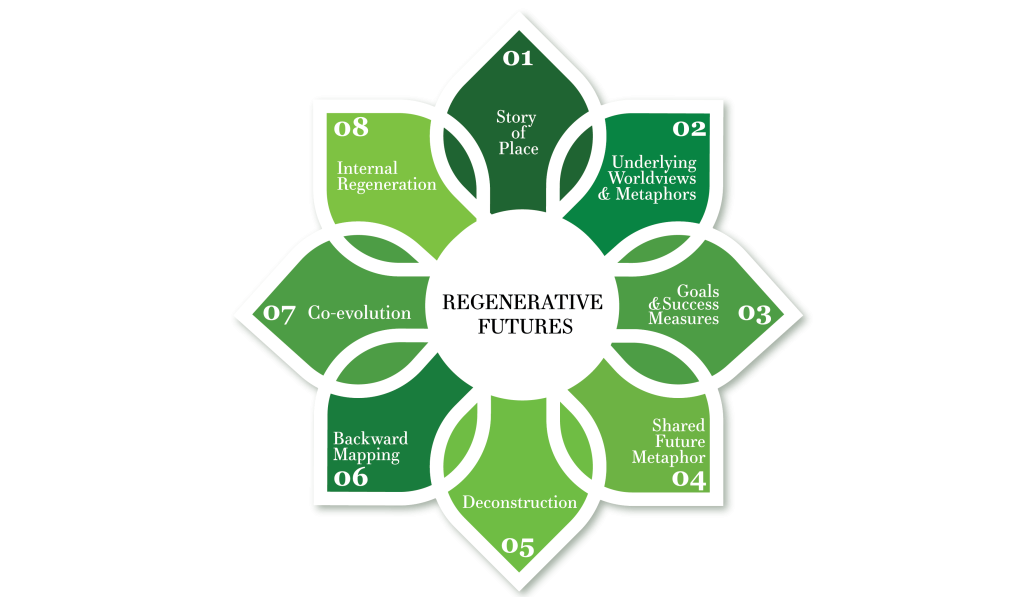
- Regenerative Futures: Eight Principles for Thinking and Practice. This article in the Journal of Future Studies “draws from extensive regenerative futures research to provide eight principles for thinking and practice“, unearthing the following principles for thinking and practice as “a springboard conceptually deepening and practically applying regenerative concepts using futures thinking and methods“:
- Regenerative Futures: From sustaining to thriving together. A wonderful exploration by the RSA in the UK of what regeneration is and what regenerative futures might look like. The author also distils 8 principles, but this time for regenerative design:
1. Start with place and context
2. Seek different perspectives
3. Build capability and reciprocity
4. Take a nested systems view of success and consequence
5. Design for circularity and circulation
6. Create space for emergence
7. Design from a hopeful vision of the future
8. Work on the inside as well as the outside
Expanding how humans question
- University of Limerick’s work on exploring regenerative futures in higher education is inspiring. For the more curious, the Tomorrow’s University Futures Report and more in-depth Higher Education Beyond the SDGs position paper (94 pages) are both worth diving into.
- Stepping outside the “traditional” institutions, Gaia Education provides “holistic education in sustainability, regenerative practices, and community development“, built on and around the core tenets of the permaculture movement.
- Fritjof Capra invites us to shift “from seeing the world as a machine to understanding it as a network“. The Capra Course is in essence an extension of his book The Systems View of Life.
Visualising the predicament
- Planetary boundaries: The planetary boundaries framework highlights the rising risks from human pressure on nine critical global processes that regulate the stability and resilience of the Earth.
- Ecological Footprint Network: The data collated by the EFN is more granular, showing the evolution of the ecological footprint and biocapacity in over 200 counties since 1961. This provides a noise and greenwashing-free view of the current predicament in each region of the planet and adds context to the planetary boundaries framework.
